Showing posts with label Childhood. Show all posts

Monday, 24 October 2011

Usherette on Duty


When a vintage motorbike with sidecar pulls up outside the venue calling itself Kirkland’s New Empire Bioscope you know it will be no ordinary trip to the cinema.

The Bioscope is an ongoing cinematic project between artists Elena Cassidy-Smith, Ruth Swallow and cinema buff John Bates. I was visiting on the last night of this four week project as my own film Trolley Happenings was being shown on their silver screen.

We climbed the stairs into the atmospheric cinema interior. With plenty of red, luxurious velvet and gold painted detailing there was immediately an air of theatricality and excitement.

I love all this kind of thing and so was especially delighted to be one of the artists whose film had been selected to shown on the screen in the Bioscope.
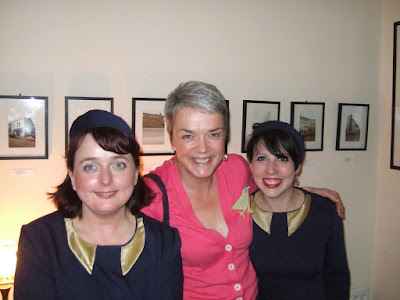
From left to right: Elena Cassidy-Smith, Kirsty E Smith and Ruth Swallow.

And not just any screen but one with a unique handmade proscenium.

I love the fact that the pelmet fringing above the screen was made from hair bobbles!

This really appeals to my interest in the provenance of materials used by artists. I am fascinated by the creative use of everyday items.

Not surprisingly during the evening I found my eyes wandering to the fringing on more than one occasion. I felt that it was even better than the lovely rich red fringing that I had used to trim my film booth when I presented Trolley Happenings as part of my show in the 2010 Liverpool Biennial.

Elena and I also have some common passions; tea trolleys being one of them.

Elena serves refreshments from her trolley during the interval on the final evening of Kirkland's New Empire Bioscope.

At one point in the evening I found myself launching into a description of one of my favourite Magic Roundabout episodes; the one where Ermintrude fancies her chances as a TV presenter. She swishes her tail and rolls a daisy in her mouth as she reaches her head through the cut-out screen of cardboard television and says, “Drink more milk darlings”.

It is at this point that I can get strange looks. I will have made one of my frequent tangental links in my head but instead of keeping it there I have spoken it out loud. The result is that people wonder why I seem to have changed the subject completely.

The explanation in simple!
The drama within this lovely little cinema was gentle and fun and not at all po-faced. It was playful while at the same time being respectful of a bygone era.

So back to Ermintrude... I love the original Magic Roundabout (with Eric Thompson doing the voiceover). It was fun and magical too; the link in my mind was that same happy feeling and a sense of childlike adventure.

Elena had made a beautiful mini-cinema (modeled on The Scala cinema, one of Wolverhampton’s old cinemas- built 1913, demolished 2006). She made this model especially to present her exceedingly old copy of a home made Alice in Wonderland film.

The story that she told me about this film made it even more intriguing. The filmmaker used his wife and children as the actors (his wife as the March Hare) and much of it was filmed in a public garden.

Her piece made me think of both dolls’ houses and imaginary miniature worlds.

In my short film Trolley Happenings, almost all of the action takes place within a hostess trolley. And most of the performers/characters that feature are little things that usually live on my mantle piece. Before dashing off to the Forkbeard Fantasy Summer School (where the film was made) the last things that I threw into the car happened to be these few vital mantel piece 'friends'.

To summarise some of the most interesting connections:
Hostess trolleys - Elena’s refreshments trolley and the one I used as a setting in Trolley Happenings
Evocative red velvet curtains - that one is obvious
Vintage projectors - I have used one as the central object within my film, and John asked me straight away about it, most people don’t realise that this machine with interesting knobs is in fact a vintage film projector.

So as I happily watched Trolley Happenings in the theatrical setting of this unique recreation of a 1930's cinema, I smiled to myself when my little one eyed waxed sponge monster did what I have always called his ‘Dougal Move’. The stop-motion animation process resulted in it appearing to swizzle about just like Dougal (coincidentally another character from The Magic Roundabout)!

But how do you explain a chain of all those thoughts in a clear and concise manner?

In conversation this is extremely difficult and we all know it's hard not to sound like someone who is jumping around subjects!

It’s interesting how one person’s ‘normal’ can be another person’s ‘a bit too weird’. When it comes to surreal I love it but to others it can be disturbing and strange, sometimes even in an uncomfortable way.

I wonder, if surreal is served up with a dash of humour does that make it easier to cope with?

I am asking this because descriptions of Trolley Happenings range from strange and weird to surreal and Jan Svankmajer-esque. So a bit too bizarre for some and quite understandable for others. However no matter which end of the spectrum viewers are on they all laugh at the very same comedy moment, so at least there is no doubt about that element of the film!

A still showing the comedy moment.

In another Magic Roundabout episode, called 'Watch the Birdie', Dougal uses an old fashioned camera with a dark cloth to cover his head and keep out the light.

As soon as I spotted this camera (see above) in The Museum of the History of Science in Oxford earlier this year I immediately thought not only of Dougal and that Magic Roundabout episode but also of this....

A prop from a Forkbeard Fantasy production which I saw behind the scenes on the film making course - another reminder of my very visual memory and the connections I often make.

So everything makes complete sense... at least to me!

I have been an avid follower of Forkbeard Fantasy for 13 years now. They intersperse live action on stage with film and projection. They have a completely off-the-wall sense of humour (quite normal in my eyes) and their productions are exceedingly surreal. To make a final cinematic link I must mention one of their shows 'The Fall of the House of Usherettes' (first staged in 1995 and set in an old cinema). To find out more about Forkbeard Fantasy don’t miss their residency at The Southbank Centre, London. 2nd Dec 2011- 8th Jan 2012.

Monday, 15 August 2011

Cosmic Communist Constructions Photographed and how monumental memories become sculpture

Buildings; what is it about them that keeps me enthralled? Is it their form, materials that they are constructed from? Or maybe it's mostly due to the feelings that they arouse in me.


There are different kinds of the feelings; those that I have now when I encounter a building as an adult and a feeling that enhances a previous feeling.


I often have a deja vu kind of enhanced experience of a building because actually it is reawakening memories from my childhood.


Re-experiencing long forgotten experiences by delving deep into my memory is what I do when I am in that half asleep half awake state. That state when almost all of my real creative work is done.


This is when you are neither here (2011) nor at some point in your past.... nor possibly (if you believe that it is possible) at some future point in your life that you do not yet recognise.


Earlier this year I bought a very much talked about book, CCCP (Cosmic Communist Constructions Photographed) by Frederic Chaubin When I ordered it I had no idea how talked about it was to become, I had simply pre-ordered it online and then forgotten about it until it arrived two months later. Little was I to know that it would inspire me on so many levels - the introductory essay alone led me to rewrite my artists statement!


It is the most wonderful book possible in my opinion. The only drawback is that it is huge and very heavy so definitely not one that you can pop in your bag for a train journey!


Not being a writer I am fining it hard to describe just how much bliss I have experienced while poring over the pages.


Obviously I have a strong interest in the Brutalist and Futuristic buildings that Chaubin has tracked down and photographed but there is also so much more to these incredible and fantastic structures.


I think that Chaubin has captured these places in such a mesmerising way that not only am I entralled by the buildings but by the sensual photographs too (so many of these I just drool over ... again ... and again).


These photographs are keys ...they are opening the doors to so many memories in my mind.


I don’t need hypnotherapy to re-visit some of the deepest and most elusive fragments of my childhood experiences of buildings and interiors, because I have begun to just open CCCP, turn the pages ... calmly, ... rhythmically, ... carefully, ... with my eyes devouring the images, ... and before I know it I have been whizzed back along some neural pathway to a snapshot in my mind - to a time and place that I didn’t even realise was so important.


Chaubin’s photograph of Zavarnots Airport Control Tower is one of my favourites, although there are so many that I have now given up marking the pages (see the plethora of sticky page markers in the photo above)!


Zavarnots Airport Control Tower is on page 118 of CCCP but in order to avoid copyright infringement here is an alternative image of it from Wikapedia. See photo below by Marshal Bagramyan.


I know that I am instantly drawn to it first because of it’s form. I already know that several of my sculptures have similar segments, and that ring of circles on the underside of the tower could so easily be buttons in my mind.


But there’s more... the view looking up from below (Chaubin’s image is even better) reminds me of that feeling of being a child and viewing the world from a low vantage point. I find myself feeling like I’m looking up at the underside of a piece of furniture... or a giant pedestal (usually for those big flower arrangements that my mum and aunties did.)


Now I am traveling deeper into my memory...

When I was 8 I accompanied my Nan (grandmother) on a trip to visit my cousins in Detroit, USA.


I wrote this postcard while on the flight.

After our long, but for me exceedingly exciting flight we landed at Toronto. Being in Toronto we had to visit the Niagara Falls. Just opposite the Niagra Falls there’s The Skylon Tower.


Zoom in on this picture to see the tiny yellow lift that travels up on the outside of the tower.

My nan was an amazingly adventurous and lovely lady. She certainly knew how to make things special for a little girl. I can’t remember even imagining the possibility of traveling up this scarily tall building but before I knew it I was in that little yellow bug of a lift and we were whizzing up the outside of the tower.


You have to remember that this was back in 1972 and I lived a quiet country life. This was exciting... oh yes! But I'm sure I would have also felt just a bit nervous being in a lift on the outside of a building!


So The Skylon tower was built in Canada in 1964... Meanwhile back in the UK another of my now favourite landmarks was built as part of the M6 motorway services at Forton. I’ve driven past so many times over the past 27 years but only just took this photo earlier this year. For lots more information and images of the building of this landmark tower visit its own dedicated website.


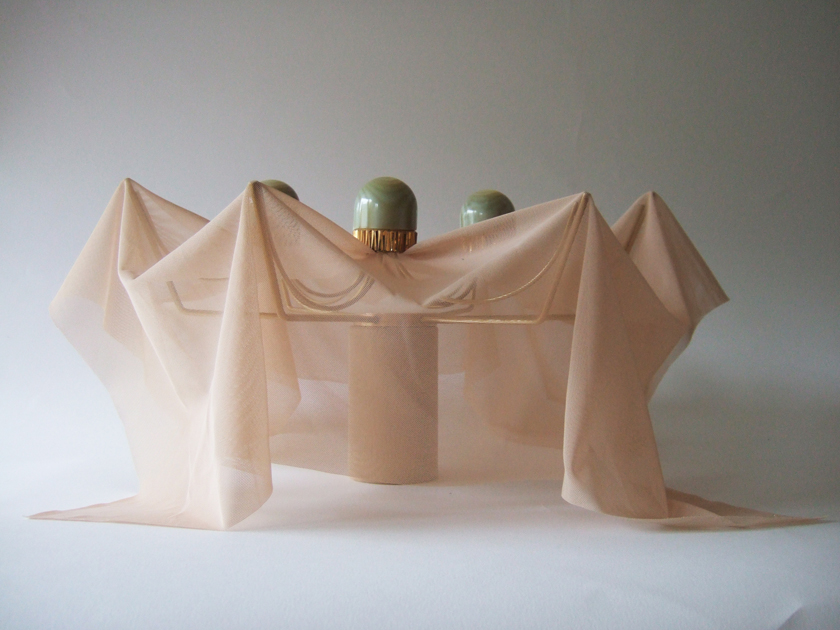
'Strange One' is my latest sculpture (being).

Photographing her was interesting. I like when you experience a sculpture over and over. I like to encounter the work and be surprised. She has been an awkward little thing. So elusive to reveal herself.


At the centre of 'Strange One' is a set of avocado green acrylic bathroom tap heads which had sat on a shelf in my studio for months. I had looked at them, held them in my hands, and felt quite intrigued by them. I knew I wanted to use them to make a Frillip Moolog being but if anyone had asked me what I was going to call her I would have said 'Margot'.

However she changed so much in the making from my first sketch to having access to the right equipment to make the brass structure. I was definitely thinking of trapezes and circuses when I did this rough sketch (see below).


Making her was a slow process and she languished on a shelf again for more months while I tried many permutations of fabrics. Right at the very end I realised that 'Margot' had grown into a much more interesting being. She became 'Strange One'.

She is fairly small but seems to have a monumental presence in her photographs.

I am enjoying her strangeness and for me this image (below) is best. I love the viewpoint; it reminds me of being a child and looking up... being open minded and full of wonder.


Post script.
Back in December 2009 we saw the Moscow State Circus perform when they visited Birmingham, UK.

Compare the photo of 'Strange One' (above) and this photo (below) of Moscow State Circus trapeze artists suspended on cables within the dramatically lit and draped circus ring.


Of course is it any surprise that the permanent home of Moscow State Circus is also included in my all time favourite book CCCP?

This photo taken from Wayfaring website.


To see Frederic Chaubin’s photo of the building see page 186 of CCCP.

This is a book worth spending time with.


Saturday, 16 October 2010

Liverpool Biennial 2010 & the Power of Chickens in Art


The Liverpool Biennial is getting a lot of attention these days. Started in 1998 by James Moores, who now runs the A Foundation, it now attracts over a million visitors. This is the 7th Biennial.
I first visited in 2002. The piece that I remember most from that year was then was Tatsurou Bashi's Villa Victoria (the one room hotel built around a bronze satue of Queen Victoria). I also visited in 2008 and the most memorable piece for me that year was was Manfredi Beninati’s ‘To Think Of Something’. I wrote about the experience (and later discovered that it was included on Beninati's Wikapedia page).
It was to be the start of my octopus style of writing with posts full of links and connections. I feel that each post now does seem to be along those lines and maybe it helps to illustrate just where I get my inspiration from… everywhere!
I do know that writing this blog has definitely helped to clarify my thoughts … especially to me.
Sometimes it is only after making a piece that I can completely understand all that I was trying to say.

So now to 2010 and here I am exhibiting in the Liverpool Biennial myself. Blink UnBlink is my joint show with Olwen Holland. More exhibition images to follow soon.

I went to Liverpool for the Touched Conference which took place on the opening weekend of the Biennial. Later that evening I found myself looking through the windows of 102 Seel Street (just around the corner from The International Gallery where Blink UnBlink is now showing).

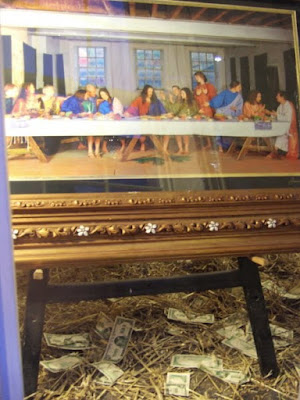
Here in the left window is The Last Supper by Francis Ewe (AKA as Gregory Scott Gurner). I had already seen the piece when I first went to meet Gregory at The International Gallery earlier this year. For the period of the biennial Gregory has installed the photograph of his re-enactment of Leonardo Da Vinci’s The Last Supper (with himself as Jesus) in the window of his home, 102 Seel Street.

It was raining, I walked across the road. I could hear sounds … they were coming from speakers positioned outside the front door. I looked into the window. Yes The Last Supper; there jewel like in its splendid ornate frame. I noticed the straw on the floor….and money… (US dollars?) scattered across the floor. (Actually I found out later that the money is Chinese Hell Money.) I realised that there was something in the adjacent window; a screen, a ripped screen. And projected onto it was a film documenting the making of The Last Supper. So this explained the soundtrack. What I could hear while standing in the rain outside Gregory’s window was the soundtrack of the making of this photograph.

Well this was all pretty good; I love theatrical and I love the unexpected. Yes even the punters in the Irish pub across the road were perfectly okay, smoking out in the rain and being subjected to a soundtrack of shuffling of boxes, a bit of music and some back ground chat. It is the Liverpool Biennial and really everyone in Liverpool, art lover or not, is up for it!

But suddenly I noticed that in amongst the straw and the money there was a hen, a real live hen!


'Fin' had only just been finished a couple of days before we set up the show and so I hadn’t had much time to ‘live’ with him at home. Had I really realised what I had made? I had worked intuitively with materials that I love; aged copper, bits of vintage machinery, plastic vinyl fabric, feathers and shepherd castors.


A week or so after seeing Francis Ewe's The Last Supper (with chickens) I realised that there was a link. I remembered that a piece that I made while in second year had strong similarities to Fin.

BUT better still when I made it I had also photographed it amongst some chickens on my friend’s farm!


Did they enhance the piece or did they help to suggest that rather than being just an object it could be something much more. A connection to another place ... a place that I have now named Frillip Moolog?

I love surprises and the chickens in the window at 102 Seel Street didn't just surprise me they have made me think even more about how I present my work.

A friend commented on my work in Blink UnBlink… she said … it’s about a fantasy world; a world to escape to, where you can be anyone and anything.
Am I that easy to read?
This is my brother and I. My real life in 1966.

And here is a fantasy version of my life.


Do I see Francis Ewe’s The Last Supper in a different light now that I have seen it with straw, Chinese Hell Money and chickens? Yes I think that the presentation definitely added to his photographic piece.
For Blink UnBlink I have shown my short film Trolley Happenings for the first time.
By presenting it on a small screen set within a red velvet tube (complete with heavy fringing) I have ramped up the theatrical. My love of performance, memories of cinemas in the 1970’s, Punch and Judy, and the Magic Roundabout is very definitely evident.

I am pleased that it has been described as having Jan Svankmajeresque qualities and the favourable comments from visitors to Blink UnBlink is encouraging me to plan future films… with chickens?


Monday, 26 April 2010

David Mellor: taking inspiration from his live work ethic, designs and craftmanship

Stories are what I thrive on; and what better than a story which starts with a teenager in Sheffield making a caravan. Scavenging for materials in post war Britain he used Ponds skin cream jars for the light fittings.

(I remember that cream, it was always really cold. I used to put a dab on my nose when I was a little girl messing around with my Nan’s toiletries.)

David Mellor is the teenager that I am describing. He went on to earn the title of "Cutlery King". But he designed so much more than just cutlery.

When I was 13 I spent a weekend in London with my Mum. It was one of those special mother and daughter weekends. We went to the V&A and to Liberty’s of Regent Street, we saw Andrew Lloyd Webber’s "Evita", we ate some very posh sausages at The Greenhouse in Mayfair (It was John Tovey’s restaurant at that time) and we also went to David Mellor’s Kitchen shop. It was 1977 so it would have been his Sloane Square shop.
Photo by Phil Sayer
The things that you accept as normal when you are a child… I accepted that when out with my mum we went to kitchen shops (usually spending the most time in the china department). My own children know that when out with me there is a very strong possibility that there is an unusual museum nearby or an art gallery at least.

I stored away all the memories from that London weekend.
It was special; we lived in Central Scotland and it was my first real trip to London.
When I got married I was 24 and I would have loved to have put David Mellor cutlery on my wedding list. I think my favourite design at that time was “Flute”. Sadly we couldn’t agree; I think that it came down to the fact that we preferred to have two spoon shapes one for soup and one for desserts. (One of Mellor’s ambitions was to refine and simplify and so he had worked on devising the fewest items of cutlery actually needed…. You don’t see fish knives and forks in a David Mellor range).
"Flute" designed in 1983. Photo by Pete Hill.

I have now been married for 22 years. And David Mellor’s career has been a notable one. Visiting London Design Week events I still drool over his designs. My favourite now? Possibly "Hoffmann".


David Mellor was an advocate of Modernism and "Hoffman" has been described as being, to some extent, an homage to early 20th Century mid-European metalwork.
I am also fascinated by people’s homes and how they live, so what a wonderful book “At Home with the Makers of Style”. Reading this book back in 2006 I studied each photograph. David Mellor is one of the designers featured in this book. It was then that I read about his Round Building cutlery manufacturing site and home in Hathersage, near Sheffield.

So this Easter we made it. The trip was first planned to go to buy some “posh sandpaper” (Micromesh finishing cloth) from Craft Supplies.
I am finally finishing a being(sculpture) called "Rachel". She’s a cross between Barbara Windsor and Mae West… so of course the sandpaper needs to be posh!
Hathersage is only 3 miles from Craft Supplies so obviously the time had come to visit The Round Building!

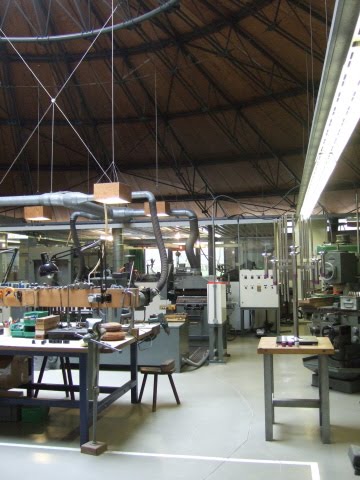
The building was designed by Sir Michael Hopkins. It was built (1990) on the foundations of an old circular Gas Storage container and has been described as minor masterpiece of modern architecture. Although my photos don't show it it sits in exceedingly beautiful countryside.

You can walk round the factory and watch the cutlery being made. Mellor was a designer who was completely involved with the making of his designs. Although he introduced a lot of technology he still retained the handmaking skills and hand finishing of each item. He admitted to being a perfectionist.

I find this machine really sculptural. I get inspiration for my Frillip Moolog beings from an ecclectic range of sources.

Not only that but he used his own workforce when building, renovating or fitting out his premises.
Of course you are going to feel pride and belonging if you actually contributed to the making of the building that you work in.
There are 480 Finnish plywood roof panels to make the roof of the Round Building; these too were made by Mellor’s own workforce.
“Mixing concrete and foundations on a bitterly cold Sunday was a typical situation which I learned to expect….working with him you surge forward on a tidal wave of unbounded enthusiasm and there is never any question of defeat”. Ron Carter furniture designer and old friend from RCA talking of his involvement with the design and shop fitting work on the Sloan Square shop.
Yes this is what you’d expect from such a name in design history; drive, passion and self belief.
Park Lane was the first of Mellor’s live work buildings. A point to note is that this building was designed (1960) with two thirds of the space devoted to design studio and manufacturing workshop and just one third for living and sleeping space. (The same proportion that he divided his time.) His bed actually slid out into the living room from under from under the kitchen work units!
Yes a driven and committed man I would have loved to have met him.
Recognise the salt and pepper set in the left of this photo? "Fanfare" condiment set was designed by David Mellor in 1961 and has been copied the world over.

Another game that I enjoy is “How Many Degrees of Separation?” I love when I can make connections and often during a chance conversation you can discover that you are more closely connected to someone than you might have believed.

Sitting in the cafe area within the David Mellor museum I discovered that the gentleman sitting beside me was Brian Edwards, an old friend of David Mellor’s. On realising that I was more interested in David Mellor than my posh sandpaper he revealed that he had known David Mellor from the early days of his career. Infact he had interviewed David Mellor for one of his very first design jobs.
Brian Edwards described his business as being office workstations specialising in Danish and Scandinavian designs. Now that I realise that he owns Shape Posture Seating I realise that I could have mentioned that I owned a kneeling stool back in the 80’s. Lots of student studying was done on it.
And also my own very early exposure to Danish design; my memories of eating Open Sandwiches at the Danish Design Centre in Glasgow. These were trips with my Nan and my mum I was very young but I definitely soaked up those sensory experiences.
Brian owns a set of David Mellor "Pride" cutlery. He started collecting it when he got married.
What a wonderful name; "Pride".
David Mellor was still a teenager when he first designed it and it went into production while he was still a student at RCA. It has now been in production for over 50 years!

Press plates for making "Pride" cutlery.

Brian Edwards was having lunch with Keith Tyssen. He introduced Keith as one of the country’s leading designers in silverware.
It was a funny feeling, I was so excited to have the chance to speak to these old friends of David Mellor’s (Keith Tyssen was quick to mention that David Mellor had given him his first “leg up” by giving him free access to use the studio space at Park Lane when he first graduated) but I didn’t want to sound too gushy. People can get the wrong idea when I get excited!

They both spoke fondly of their friend; sadly David Mellor died last year. But how lovely that they can still meet, to discuss design, appraise architecture and have a lovely lunch surrounded by reminders of their old friend and colleague.

And finally how to make this connection even closer?

I asked if Keith knew Christine Rew, Art Gallery and Museums Manager at Aberdeen Art Gallery
(Her dad and my dad were best friends from their Glasgow schooldays.)
Aberdeen has a very impressive collection of silverware and actively invests in work by contemporary makers so it was no surprise that Keith has met Christine. Yes he has work in Aberdeen Art Gallery’s collection.

So not bad for a spur of the moment trip for some posh sandpaper!
Examples of David Mellor's designs for street furniture: traffic lights, pedestrian crossing equipment, waste bins, the square letterbox and bollards amongs others. So certainly not "just " the Cutlery King. David Mellor's designs are all around us. He has had a huge impact on our British visual culture.